
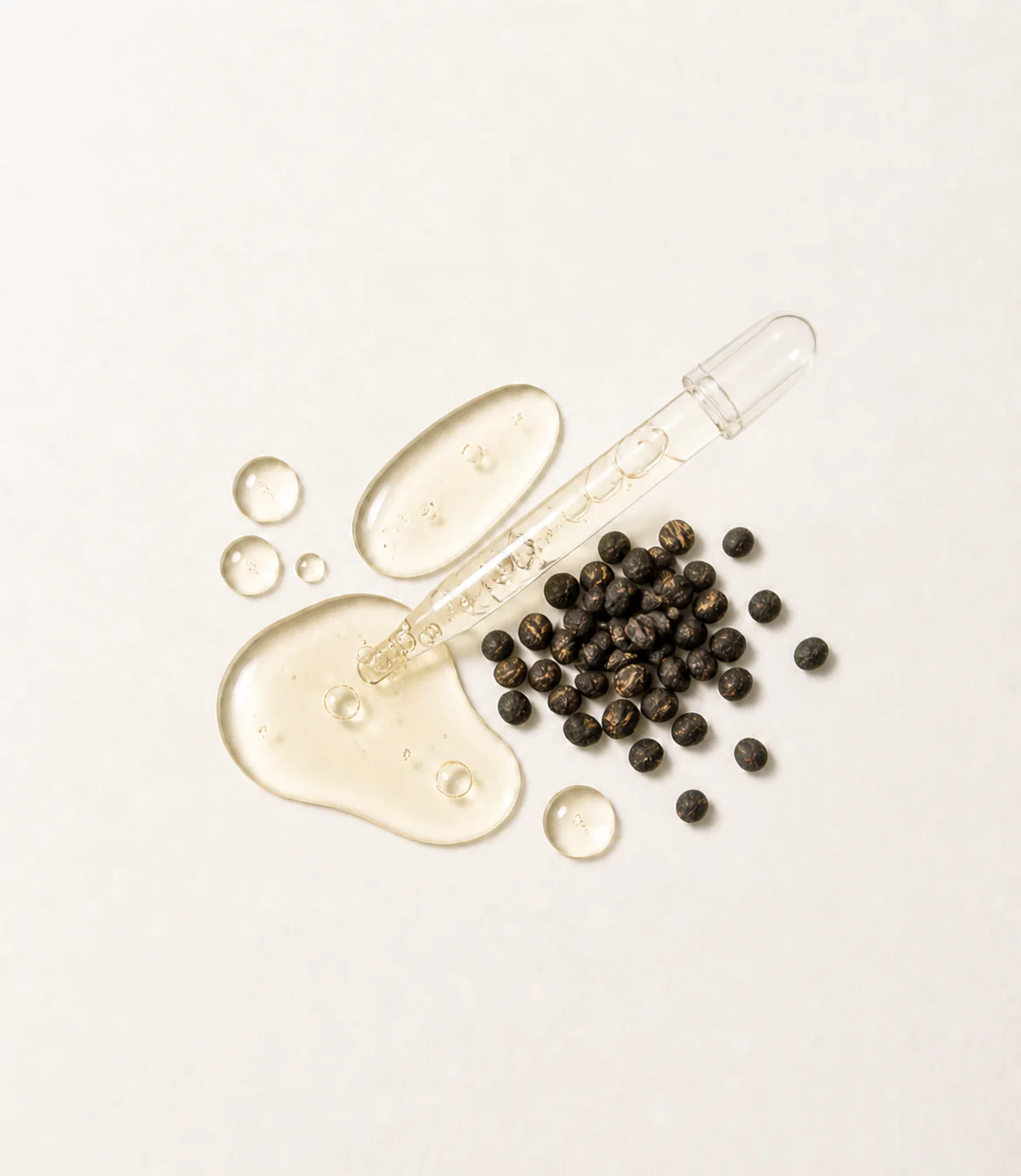
1. Start with the ingredient identity
Bakuchiol is a phenolic meroterpene associated with Psoralea corylifolia, also called bakuchi or babchi. A purified commercial Bakuchiol ingredient is identified by INCI Bakuchiol and CAS 10309-37-2. The shared botanical context does not make purified Bakuchiol and seed oil equivalent: buyers should compare identity, composition, assay and applicable impurity controls.
2. What has Bakuchiol been used for in published skincare research?
Topical studies have examined formulations developed around visible photoageing-related concerns, including wrinkles and uneven pigmentation. Mechanistic literature also discusses antioxidant, inflammatory and skin-ageing pathways. These findings are useful for forming development hypotheses, but they do not prove the performance of PINHONBIO® PH-XPNS 005 or a customer's finished formula.
3. What does the Bakuchiol versus retinol study show?
A prospective randomized study enrolled 44 participants for 12 weeks. It compared 0.5% Bakuchiol cream used twice daily with 0.5% retinol cream used daily. The paper reported improvements in measured photoageing-related outcomes in both groups and more scaling and stinging reported by retinol users.
The comparison needs boundaries. Bakuchiol and retinol were different ingredients used on different schedules. The study evaluated specific formulas in a defined population and period; it did not establish chemical equivalence, universal interchangeability or a claim for every commercial Bakuchiol grade.
4. Why 0.5% is not a universal recommended use level
The 0.5% figure records what one study tested. It does not replace the raw-material supplier's current TDS, the formulator's safety assessment, the selected vehicle, processing and packaging review, or stability and performance testing of the complete formula. A study concentration should be cited as research context, not copied into a formula as a default instruction.
5. What do reviews say about the evidence base?
Systematic reviews describe encouraging clinical findings while also identifying limitations: small participant groups, short study periods, different vehicles and combination formulas, and relatively few randomized or vehicle-controlled studies. This makes broad numerical promises or direct formula-to-formula transfer inappropriate. More rigorous controlled research is still useful.
6. Bakuchiol vs retinol: a practical distinction
| Question | Practical answer |
|---|---|
| Are they the same molecule? | No. Bakuchiol is not a vitamin A derivative. |
| Has a topical study compared them? | Yes, in specific 0.5% formulas with different application schedules. |
| Can retinol formulation data be reused? | No. Solubility, compatibility, oxidation and finished-formula behaviour must be evaluated for Bakuchiol. |
| Can one replace the other automatically? | No. Treat substitution as a new formulation and claims-validation project. |
7. How is Bakuchiol handled in cosmetic formulation development?
PINHONBIO® PH-XPNS 005 is described as oil-soluble. Formulators should define the oil phase or solubilization route and evaluate clarity, crystallization, colour, odour, compatibility and active-content retention. Process exposure, light and oxygen, antioxidants where appropriate, primary packaging, accelerated stability and the intended finished-product format all belong in the project review.
No universal PINHONBIO® pH range, processing-temperature limit or use level is stated here without an approved current formulation document.
8. How should buyers evaluate 99% Bakuchiol?
- Identity: Bakuchiol, PH-XPNS 005, INCI Bakuchiol and CAS 10309-37-2 should agree.
- Grade and method: review the 99% HPLC specification and its reporting basis.
- Batch evidence: use the COA corresponding to the supplied lot; do not treat a historical result as a permanent guarantee.
- Impurity questions: ask which controls, including relevant furanocoumarins such as psoralen and angelicin, apply to the exact offered material.
- Development support: request a sample and confirm formulation, packaging and destination-market questions.
Frequently asked questions
What is Bakuchiol?
Bakuchiol is a defined oil-soluble cosmetic ingredient with INCI Bakuchiol and CAS 10309-37-2. Purified Bakuchiol is not the same commercial material as bakuchi or babchi seed oil.
Is Bakuchiol retinol?
No. Bakuchiol and retinol are chemically different ingredients. A comparative topical study does not make them interchangeable.
What was tested in the Bakuchiol versus retinol study?
One 12-week randomized study compared a 0.5% Bakuchiol cream used twice daily with a 0.5% retinol cream used daily in 44 participants.
Is 0.5% the recommended Bakuchiol use level?
No. It is the concentration used in one published formula. A suitable level depends on the current TDS, safety assessment, vehicle and finished-product evidence.
Is Bakuchiol oil-soluble?
PINHONBIO® PH-XPNS 005 is described as oil-soluble. Formulators should still test the selected oil phase or solubilization route, process, packaging and complete formula.
What should buyers verify before purchasing 99% Bakuchiol?
Match the name, product code, INCI and CAS; then review the HPLC specification, analytical basis, applicable impurity controls and the COA corresponding to the supplied batch.