
Start with the conclusion: no single grade fits every formula
Commercial Dihydroavenanthramide products may be supplied as a neat high-purity powder, a premixed solution or a salt form. These formats differ in active-content basis, solvent contribution, dissolution route and formulation behavior, so the name alone is not enough and a higher number does not automatically mean easier use.
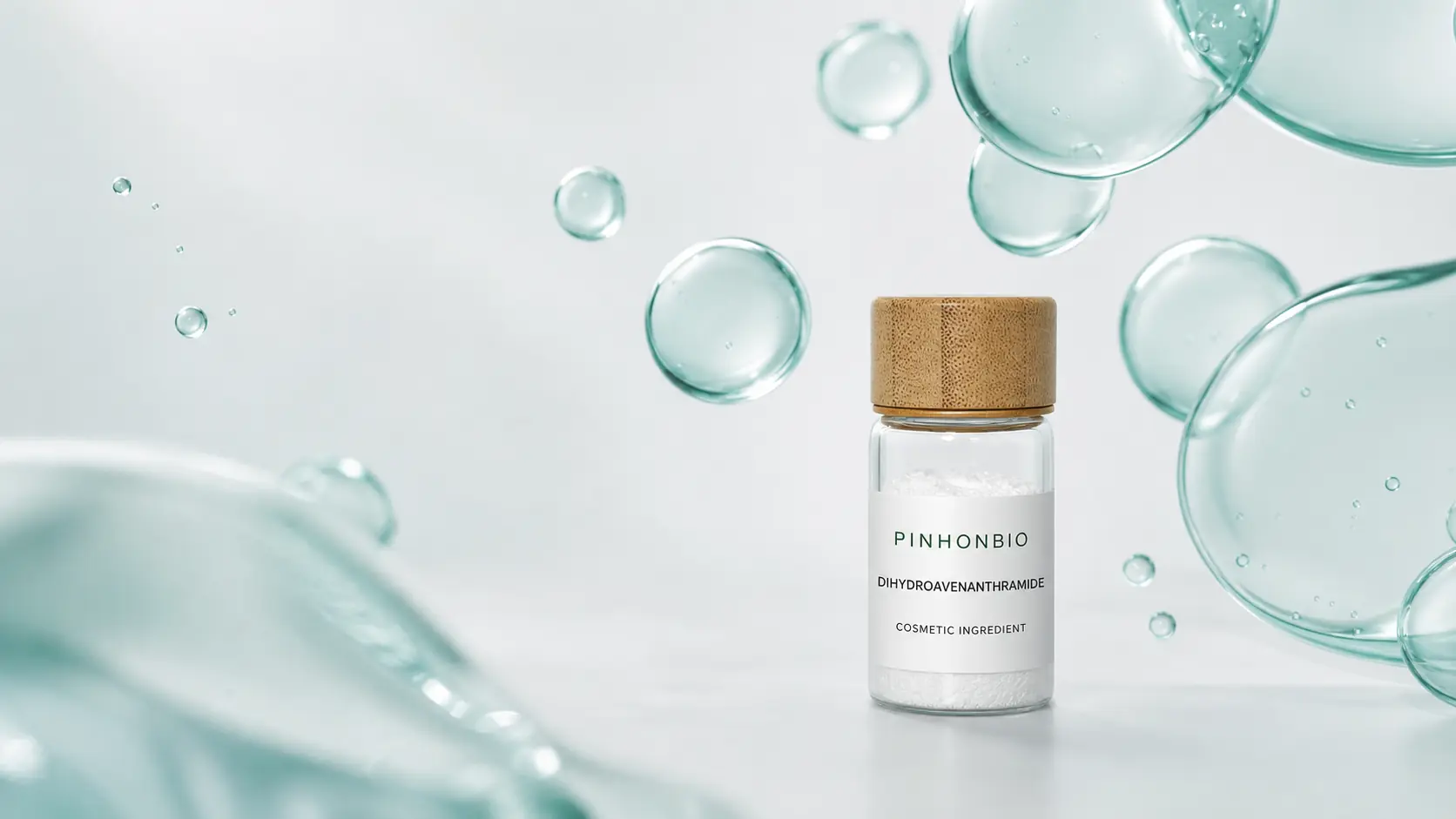
For PINHONBIO®, the available routes are clear: PH-SynBio 002 is the 99% neat powder; a solution can be prepared on request after the active concentration and solvent system are agreed; PH-XPNS 002 is a ≥99% water-soluble monosodium salt powder. A disodium salt grade is not offered.
A sound selection sequence is to confirm product identity and composition, define the formulation system and process conditions, review the quality specification and test method, and then determine suitability through graded use levels, bench observations and stability testing.
Step 1: confirm the commercial product form
When requesting a quotation or sample, first confirm the product name, INCI name or chemical identity, CAS information, active content, salt form, and carrier or solvent composition. Products with similar names may use different solvents, solubilizing systems or salt forms, and their commercial concentrations can vary substantially.
A high-purity solid lets the formulator prepare a project-specific concentration, but the dissolution medium, addition sequence, temperature and dispersion conditions normally need to be established internally. A premixed solution is more direct to use, but both its active concentration and solvent contribution must be included in the formula; price per kilogram alone is not a sufficient comparison.
Step 2: narrow the choice by dosage form and solvent system
First identify whether the product is an emulsion, cream, clear aqueous product, spray, serum or cleansing system. Then review the continuous phase, alcohol or polyol level, surfactants and thickening system. Different commercial forms can disperse or dissolve differently in these systems.
For clear aqueous products, also observe clarity, color, low-temperature crystallization and sediment after storage. For emulsions, assess the addition stage, differences between pre- and post-emulsification addition, viscosity change and centrifuge behavior. Supplier dissolution guidance is a starting point for bench work, not a substitute for formula-specific verification.
Step 3: include pH and process conditions
A monosodium salt and a disodium salt are not interchangeable labels. They represent different neutralization states and may respond differently to pH, ionic strength and co-ingredients. Define the target pH and acceptable variation before selection, and observe the solution both before and after acid or alkali adjustment. PINHONBIO® supplies the monosodium salt only; disodium salt is included here solely as a comparison category.
Heating temperature, hold time, addition sequence, shear and cooling can all affect final appearance. Begin with a small-volume dissolution test before moving into the complete formula, and do not scale up without verification.
Step 4: do not compare only stated purity and price
Compare cost on the same active-content basis and include solvents, solubilizers, production handling, filtration, rework and storage management. A high-purity solid may have a clearer cost per unit of active, but its preparation conditions and operating cost also matter. For a premixed liquid, assess how its solvent load affects the original formula.
Stated purity does not describe total quality. Also review appearance, odor, moisture, related substances, residual solvents, applicable risk items, microbiological limits and batch consistency. The exact controls should reflect the ingredient identity, synthesis or purification route and target market.
Step 5: review the Specification, COA, TDS and SDS
Use the Specification to confirm release tests and acceptance limits, the COA for the actual supplied batch, the TDS for typical technical parameters and suggested use, and the SDS for safe handling, storage and emergency information. These documents serve different purposes and do not replace one another.
Check the product code, active content and test method, pH or solution parameters, solvent and carrier composition, residual controls, storage conditions, shelf life and revision date. Product names and grades in the documents should match the actual sample label.
Step 6: make the final decision with bench and stability data
Test multiple use levels and addition routes. Record initial appearance, pH, viscosity, color, odor, clarity or dispersion, then conduct centrifuge, heat-cool cycle, high- and low-temperature, light or other observations under the company’s methods. Conditions should match the dosage form, packaging and intended storage environment.
If cloudiness, precipitation, color change or viscosity drift occurs, review the commercial form, solvent contribution, pH, ionic strength, addition sequence and co-ingredients in order. Do not judge ingredient quality from a single observation alone.
Eight questions to confirm before requesting a sample
Confirm the exact chemical form, how active content is calculated, the test method, other solvents or carriers in the commercial product, the suggested dissolution medium and addition sequence, the suggested pH range, available batch-quality and stability information, and how changes to the specification, process or source are communicated.
A supplier that can answer these questions clearly and provide consistent samples, labels and documents gives formulators a stronger basis for evaluation than a high-purity number alone.
In one sentence
To select Dihydroavenanthramide, first confirm what the commercial product is, then determine whether it can enter the formulation system, and finally use document review and bench testing to establish whether that batch fits the project.
Buyer and formulator checklist
- Exact chemical form
- Active-content calculation basis
- Analytical method
- Solvent or carrier composition
- Suggested dissolution medium and addition sequence
- Suggested pH range
- Batch-quality and stability information
- Specification, process and source change notification